

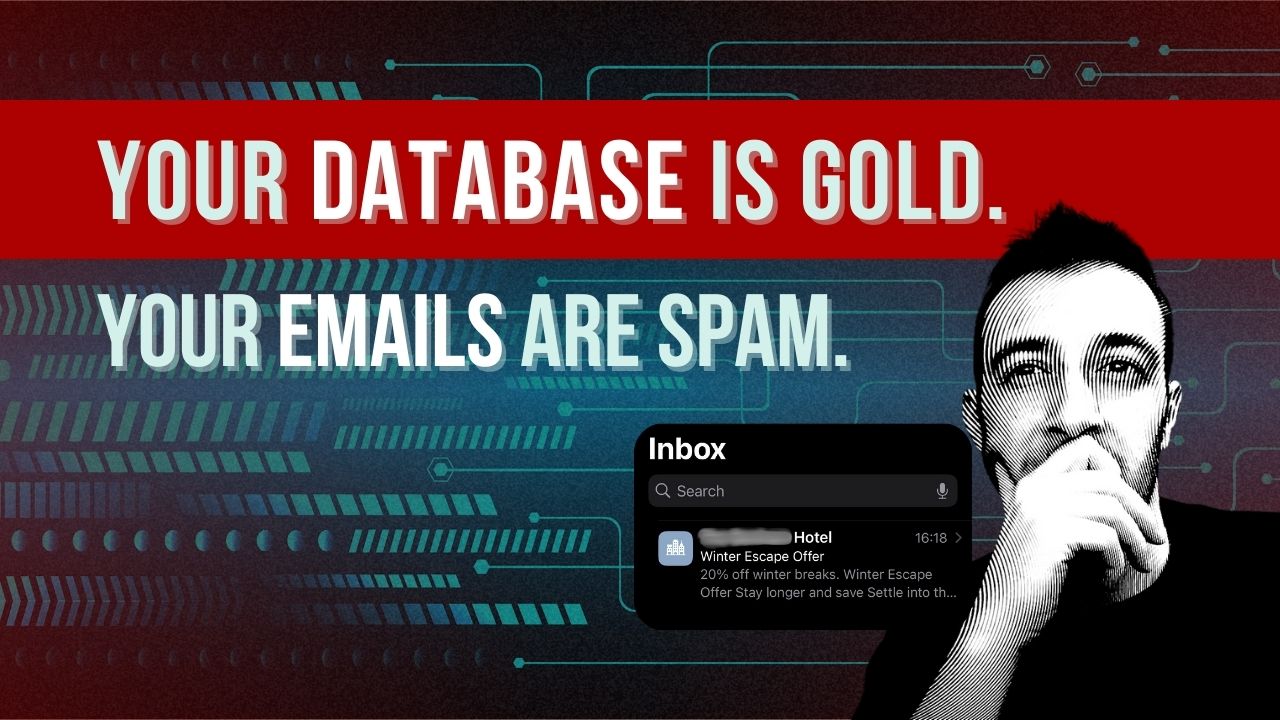
I deleted a hotel newsletter this morning without opening it.
It wasn’t the first time. I get these emails almost daily, usually from hotels I’ve stayed at before. Which makes it worse, because I’m exactly the person they should be converting.
According to Campaign Monitor, the average open rate for hospitality email marketing sits around 20-25%. That means 75-80% of your past guests never see what you’re offering. But the real problem isn’t the open rate. It’s that most hotel newsletters are designed to be ignored.
Generic subject lines. Wasted preview text. Discount percentages without context. Messages that assume demand exists when it doesn’t.
This isn’t a small problem. Your past guest database is one of your most valuable assets. These are people who already know your property, have a positive experience to reference, and are significantly cheaper to convert than cold traffic.
Yet most hotels treat them like a mass mailing list instead of an opportunity for genuine reconnection.
Here’s what’s going wrong, and what to do instead.
The Newsletter I Got This Morning
Before we get into solutions, let me show you what triggered this post.

Subject: “Winter Escape Offer”
Preview: “20% off winter breaks. Winter Escape Offer Stay longer and save Settle into th…”
I deleted it immediately. Here’s why.
Problem #1: Generic Subject Lines Create Zero Curiosity
“Winter Escape Offer” could be from any hotel in any location. There’s nothing specific, nothing intriguing, nothing that makes me want to open it.
Your subject line has one job: make someone curious enough to click. Generic seasonal phrases don’t do that. They blend into the noise of every other hotel doing the exact same thing.
What works instead:
Subject lines that create a specific mental image or reference a concrete event. Not “Summer Special” but “Rooftop cinema returns, June 15-17.” Not “Spring Break Offer” but “Cherry blossoms peak this weekend, balcony rooms available.”
Specificity beats generality every time.
Problem #2: Preview Text That Repeats the Subject Line
Look at that preview again: “20% off winter breaks. Winter Escape Offer Stay longer and save…”
It repeats the subject line, then cuts off mid-sentence. This is wasted real estate.
The preview text is the second thing people see in their inbox, right after the subject. It’s your chance to add one compelling reason to open the email. Instead, most hotels use it to say the same thing twice.
What works instead:
Use the preview to add new information that complements the subject. If your subject is “Live jazz this weekend,” your preview could be “Three nights with the Marcus Quartet. Limited tables, dinner from 7pm.”
Subject + Preview should work together to build curiosity, not compete for the same space.
Problem #3: Percentage Discounts Without Context Mean Nothing
“20% off winter breaks.”
20% off what exactly?
Unless I remember your rates (and I don’t), that percentage is just a number. 20% off €100 is €16 saved. 20% off €400 is €80 saved. Which one applies here? No idea.
Percentage discounts only work when the recipient already has a clear price anchor in mind. For past guests who stayed 6-12 months ago, that anchor doesn’t exist anymore.
What works instead:
Either show the actual price (“Winter rates from €180/night, usually €240”) or skip the discount entirely and focus on value. “Three-course dinner included” is often more compelling than “15% off.”
Give context or give specifics. Don’t give percentages in a vacuum.
Problem #4: Discounts Don’t Create Reasons to Travel
This is the biggest issue, and the one most hotels miss completely.
I stayed at this hotel once. I had a reason to be there: work trip, family visit, wedding, conference, something specific. That reason brought me to the location. The hotel was the solution to “where do I stay,” not the motivation to travel.
A discount doesn’t create a new reason to visit that location.
Unless your hotel is a true destination (safari lodge, ski resort, beach resort where the property itself is the draw), past guests need a motivation to be in your area before your offer becomes relevant.
Giving me 20% off doesn’t answer the question: “Why would I travel there right now?”
It’s like giving me 20% off ski equipment when I live at the beach. The discount is irrelevant because the underlying need doesn’t exist.
What works instead:
Create or highlight a reason to visit. A local event (“Truffle festival returns October 12-14”). A seasonal moment (“Firefly season peaks this week, garden tours at sunset”). A new experience (“Chef just launched the tasting menu you asked about last time”).
Give them the reason to travel. Then your hotel becomes the obvious choice for where to stay.
Problem #5: Vague Timing Makes It Easy to Ignore
“Winter breaks” = when exactly?
December? January? February? For families? Couples? Solo travelers?
The vagueness creates decision fatigue. Without clear dates or a specific window, there’s no urgency and no easy way to evaluate if the offer applies to me.
What works instead:
Specific dates create urgency. “January 15-22” is easier to act on than “winter.” Real scarcity works better than artificial urgency. “8 rooms left for Valentine’s weekend” beats “Book now before it’s too late.”
Be specific about when, and be honest about availability.
Problem #6: Adding Barriers Before Someone Decides to Come
“Stay longer and save.”
So not only do I need a reason to visit, but I also need to extend my stay to unlock the discount?
That’s asking someone to solve two problems (motivation to travel + extending their trip) before they even consider booking.
For most business travelers, solo weekenders, or people with tight schedules, minimum night requirements are a deal-breaker, not an incentive.
What works instead:
Make the base offer valuable on its own. If you want to incentivize longer stays, structure it as an upgrade or add-on. “Book 2 nights, third night upgrades to suite” is more compelling than “20% off if you stay 3 nights.”
Remove friction, don’t add it.
What Actually Works: A Real Example
Here’s an alternative newsletter I would have opened:
Subject: Live jazz, log fires, January storms
Preview: Three weekend evenings (Jan 17,18,19) with the Marcus Quartet. Dinner from 7pm, music from 9pm. Limited tables, locals already booking.
Why this works:
- Specific reason to come: live jazz event (not just “we exist”)
- Urgency: specific dates and limited availability
- Social proof: locals are booking (FOMO)
- Sensory details: log fires + storms = cozy atmosphere without saying “cozy escape”
- Subject and preview work together: one paints the scene, the other adds logistics
No discount mentioned. No “stay longer.” No vague seasonal language.
Just a clear reason to visit on specific dates.
3 More Examples of Effective Hotel Newsletter Subject Lines
Example 1: Seasonal + Specific
Subject: Cherry blossoms peak this weekend
Preview: Balcony rooms with park view still available. Breakfast included, late checkout Sunday.
Why it works: Natural event creates urgency, room type is specific, benefits are clear.
Example 2: Local Event + Positioning
Subject: Marathon Sunday means road closures (we’re inside the zone)
Preview: Book now, walk to the start line. Pasta dinner Saturday, recovery brunch Monday.
Why it works: Solves a logistics problem, positions hotel as convenient, adds relevant services.
Example 3: Memory Reactivation
Subject: Your favorite corner table is waiting
Preview: Same view, new seasonal menu, that wine you asked about last time just arrived. Thursday-Monday, March 6-10.
Why it works: Personal reference to past stay, new reason to return (menu + wine), specific dates.
Framework: How to Write Hotel Newsletters Past Guests Actually Open
Step 1: Start with the reason, not the discount
Ask: “Why would someone want to be in our location right now?”
- Local event
- Seasonal moment
- New experience at the property
- Something that’s changed since they visited
Step 2: Make subject + preview work together
Subject = hook or main reason Preview = supporting detail or urgency Never repeat the same information
Step 3: Be specific about timing
Use actual dates, not vague seasons Create real urgency through scarcity or events Avoid artificial deadlines (“offer ends soon”)
Step 4: Reference their previous experience when relevant
“The room you stayed in last time” “That dish you ordered twice” “Remember the sunset from the terrace?”
Step 5: Remove friction
Make it easy to say yes Don’t add minimum night requirements unless necessary Clear CTA with simple booking path
Step 6: Test and measure
Track open rates by subject line type See which reasons drive bookings (events vs. seasonal vs. new offerings) Double down on what works for your specific audience
Common Questions About Hotel Email Marketing
Q: Should I ever use discounts in newsletters?
Yes, but not as the primary message. Discounts work best when they’re attached to a clear reason to visit. “Jazz weekend rates from €180” is better than “20% off all January bookings.”
Q: How often should I email past guests?
Depends on your property type and what you have to share. Monthly is standard for most hotels. More frequent if you have regular events or seasonal moments worth highlighting. Less frequent if you’re a remote destination where visits are once-every-few-years occasions.
Q: What if we don’t have events or experiences to promote?
Create them, or highlight what’s happening locally. Partner with nearby restaurants, wineries, attractions. Your newsletter can be the bridge between your guest and the destination, not just your property.
Q: Should I segment my past guest list?
Absolutely. Business travelers need different messages than leisure couples. Segment by: reason for original stay, season they visited, how recently they stayed, what they spent on property.
The Bottom Line
Most hotel newsletters fail because they’re built around what the hotel wants (bookings, revenue, occupancy) rather than what the guest needs (a reason to travel, a clear value proposition, easy decision-making).
Your past guest database is valuable because these people already trust you. They’ve stayed with you, they know your property, they have positive associations to build on.
Don’t waste that advantage with generic offers and vague seasonal messaging.
Give them a specific reason to return. Make it easy to say yes. Remove friction instead of adding it.
Price doesn’t generate travel demand when the reason to travel doesn’t exist yet.
Want help building an email marketing strategy that actually drives direct bookings?
At Direct Your Bookings, we help independent hotels develop guest retention strategies that go beyond generic discounts. From segmentation to content strategy to conversion optimization, we focus on what actually moves the needle: genuine reconnection with past guests.
Contact us to discuss your hotel’s email marketing approach.


