Most advice about hotel website FAQs starts from the hotel’s point of view, with the questions the front desk is tired of answering.
We wanted to start from the other side, so we tracked every single FAQ click on the website of a hotel we work with on Lake Como.
The ranking that came out challenges some assumptions about what a hotel website is for, beginning with the question at the very top.
How we tracked what guests ask
The hotel’s website has an FAQ section built on three levels: getting to know the destination, comparing towns and areas around the lake, and the practical details about the hotel itself.
Every question is tracked as an event in GA4, so a click means a real person opened that specific question.
Over 90 days, roughly 15,000 users visited the website, and more than 6% of them opened at least one FAQ.
Not bad for a section that most hotels park at the bottom of the page, just above the footer, where almost nobody scrolls.
And once people get there, they stay: on average, each of those users opened almost three questions.
So the FAQ section behaves less like a service page and more like a path guests walk through while they make up their mind.
Which raises the obvious question: what are they actually asking along that path?
The most clicked question has nothing to do with the hotel
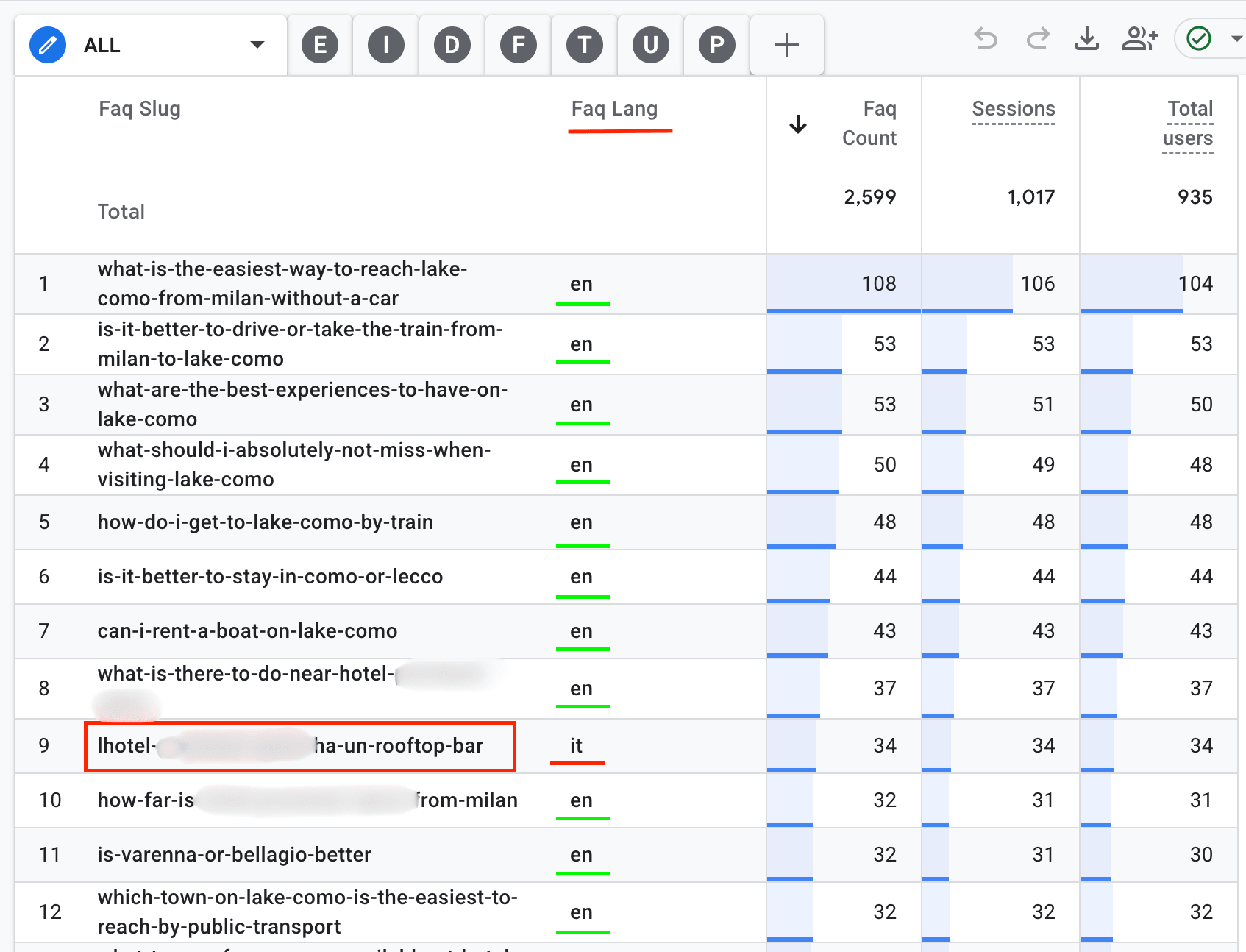
The question at the top of the ranking collected 108 clicks, double the second one: “what is the easiest way to reach Lake Como from Milan without a car”.
Read it again and notice the last three words.
“Without a car” is the real signal: the biggest worry of the international guest is logistics, not amenities.
And it is no outlier, because almost half of the clicks at the top of the ranking go to questions about how to arrive or how to get around.
On most hotel websites, all of that demand lands on a line in the footer with an address and an embedded map.
The data argues for something else entirely: a proper hub page, in English, that walks the guest through the trip from Milan by train and explains what changes when you travel without a car.
There is more validated demand for that page than for anything else on the site.
The second thread: what the stay will actually feel like
Logistics is the loudest theme, but scroll down the ranking and a second thread appears.
Guests want to picture the days themselves: the best experiences on the lake, what not to miss, whether they can rent a boat.
So the destination questions run along two threads, getting there and living it once you are there.
Neither thread is about the hotel.
Put the two together and they describe a guest who is still building the trip, and who is using your website to do it.
Guests are using the website before they choose where to stay
Building the trip sometimes means the guest has not even picked your town yet.
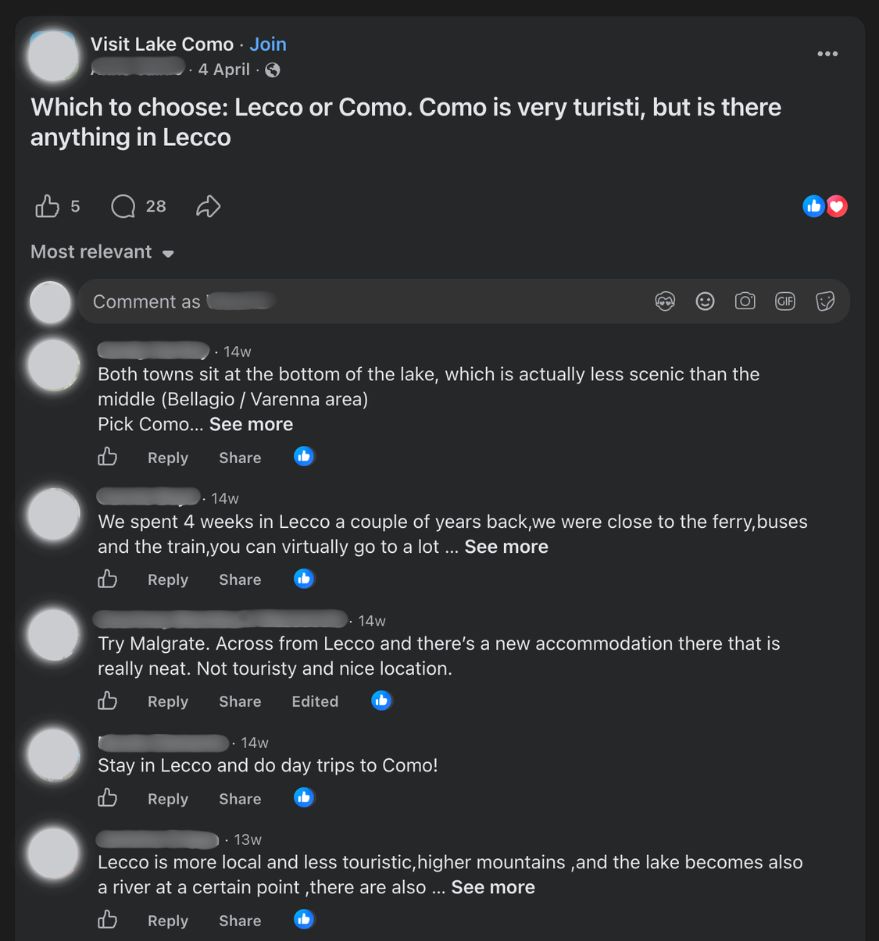
Some of the most clicked questions compare destinations: better to stay in Como or in Lecco, which village on the lake deserves the visit.
Guests are asking a single hotel’s website which town they should sleep in.
Answering a question like that feels risky, because an honest answer might point the guest to the town next to yours.
What we observe is the opposite dynamic.
The guest who finds the comparison answered on your website has just found a source of trust, and your hotel stays on the shortlist while they keep planning.
The guest who finds nothing leaves to ask Google or ChatGPT, and from that moment the conversation happens somewhere you do not exist.
One website, two very different audiences
There is one more split in the data, and it runs along the language line.
Of the 12 most clicked questions, 11 are in English.
The only Italian one is about a service of the hotel, its rooftop bar.
Looking at the full dataset, the pattern we read is that domestic guests skip the destination questions almost entirely and go straight to the practical side of the hotel, from cancellation policies to what the rooms are like.
To be clear, that second part is our reading of the data, not a number we can put on a chart yet.
Still, the implication is worth sitting with: the English and Italian versions of a hotel website probably should not be the same structure translated word for word.
The international guest needs a destination-first site that helps them build the trip.
The domestic guest, who already knows the lake, needs a hotel-first site that gets policies and services out of the way quickly.
Almost every hotel website we see is a 1:1 translation, which means at least one of these two audiences is being served the wrong architecture.
Your FAQ ranking is market research you already paid for
Everything above came out of one tracked FAQ section, and that is the wider point.
Once the questions are tracked, the click ranking becomes a demand ranking, segmented by language, written in the guests’ own words.
That has uses well beyond the FAQ section:
- Blog and SEO: every top question is an article with demand already validated, no keyword tool needed.
- Pre-stay emails: the top answers per language become the pre-arrival sequence, transport guides for one market, service details for the other.
- Ads: an angle validated by real clicks beats an angle from a brainstorming session.
- AI assistants: the questions are already in natural language, which is exactly the format that gets cited when travelers ask ChatGPT or Perplexity about the destination.
One caveat, because it matters: we have not connected these clicks to bookings, so nothing here claims that FAQs convert.
What the data does show is where the attention of a planning guest actually goes.
A showcase or a guide?
A showcase website answers the questions the hotel wants to be asked, not the ones guests actually ask.
The classic hotel site, rooms and gallery and a paragraph about the charm of the lake, answers almost none of the questions at the top of this ranking.
For the international market, the data suggests that helping the guest build the trip and selling the room are the same job, in that order.
If your website tracks anything, start tracking the questions.
Then look at your own ranking and ask yourself how many of those questions your site answers today.
If you run the exercise, I would be curious to hear what your number one question turns out to be.