Hotel distribution can affect advertising results more than the quality of the campaigns themselves.
That sentence tends to land badly, and I understand why: the campaign is the part you can see, open, adjust and blame.
What follows is about the part of your direct booking strategy you cannot see from inside the ad account, why a well built campaign can go quiet even on a brand new account, and what I would compare before signing off on a bigger budget.
The campaign does its job up to the click.
You can build excellent campaigns on Meta, on Google, or anywhere else, and from one moment to the next they can stop producing results.
The impressions are still there.
The people arriving on the site are still the ones you wanted, searching for exactly the kind of stay you sell.
The platform is the natural place to go looking for the explanation.
Audience and targeting get checked first, and when neither of them explains anything, the algorithm takes the blame.
I look at it from the other side, at what your guest has in front of them in the seconds when they decide where to book.
That moment happens on your site and on an OTA page at the same time.
How to check whether distribution is behind the drop.
Reading the data properly comes before any conclusion, and I would start from the two campaign types that sit closest to the decision.
If you have been seeing a drop in ad performance and you want to know whether distribution is the area to look at, this is what I would do:
- Isolate your brand protection campaigns on Google. Those catch mostly people who are already very close to booking, and often comparing your site and your booking engine against the OTAs.
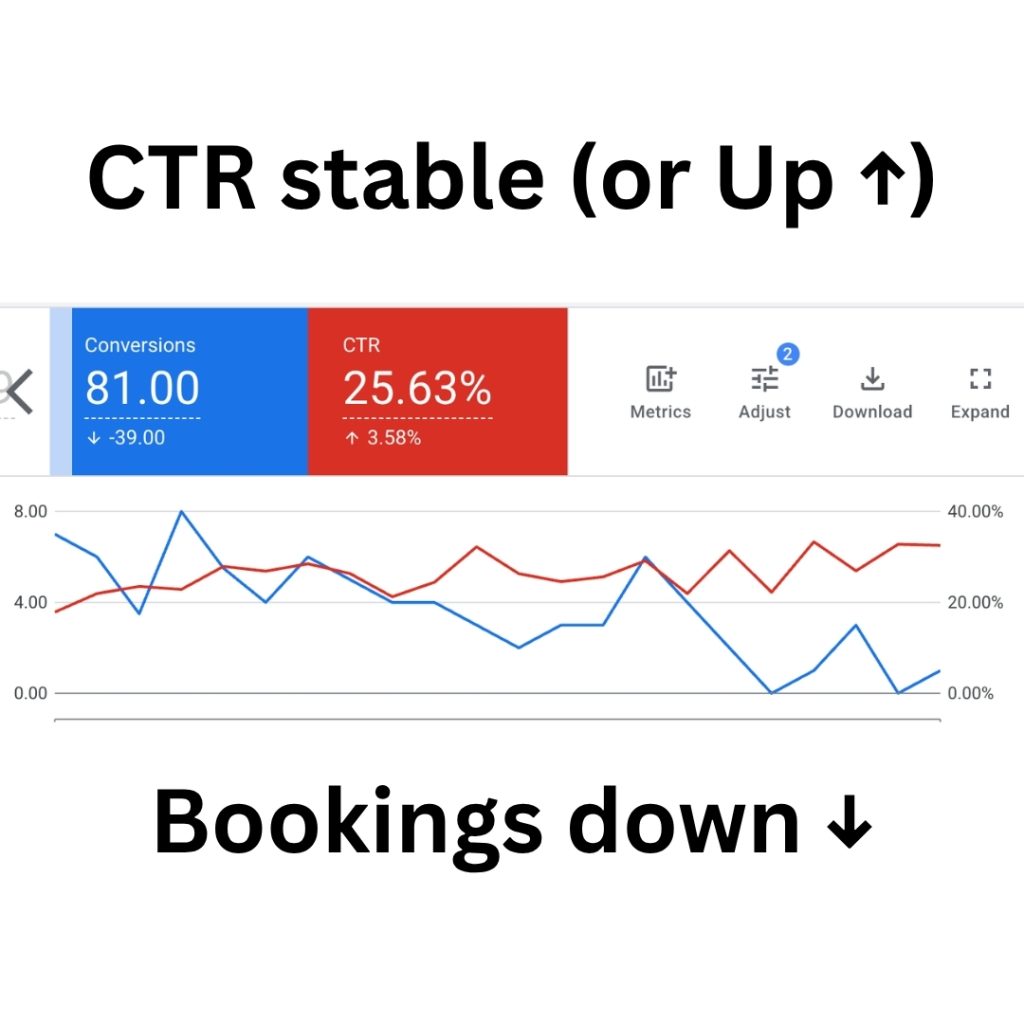
- Look at impressions and CTR. If they stay more or less the same while conversions drop, that can be a signal of a distribution problem.
- Run the same check on the retargeting campaigns that explicitly invite people at the bottom of the funnel to book direct. Conversions down with impressions and CTR stable makes it likely that your guests are booking somewhere else.
Both campaign types work on the same logic.
When the same volume of people, at the same distance from the decision, keeps clicking and stops booking, my reading is that the change sits in what they find at the end of the click rather than in how they got there.
What else could explain it.
Distribution does not get to explain everything, and I would be careful with anyone who tells you otherwise.
Maybe they’re booking a different hotel (but that’s another story…), or simply they find a better rate, or better conditions, for your hotel.
There is also a mechanical limit worth knowing before you read too much into a dashboard.
A booking that closes on an OTA does not appear in your site’s conversion data.
The campaign shows up as traffic that did not convert, without a single line telling you where that person went.
So your own analytics can tell you that something stopped working, and cannot tell you on its own that the campaign stopped working.
Why a guest books on the OTA even at equal conditions.
Say you have checked, the rates match, the conditions match, and the booking still closes somewhere else.
An OTA carries the trust of a platform your guest already knows and has used more than once, and the loyalty and points programs sitting on top of that give them one more reason to finish where they started.
It’s normal behavior, but it should be avoided as much as possible.
What this does to your advertising is simple enough.
If the only difference between your site and the OTA page is the final price, or a cancellation policy that bends slightly more, your own channel stays the less competitive option even when it is technically the cheaper one.
Paying to bring a guest where direct is not the better deal.
There is nothing more frustrating than paying to bring users to your site, only to see them book on the OTAs.
You paid for the click.
You paid for the comparison that followed it.
The commission still goes out, and this time you also paid for the traffic that produced the intermediated booking, which is the kind of arithmetic I worked through in why more direct bookings can mean less total revenue.
At the moment of choice what counts is the real value of the offer.
Advertising an offer that also sits on the OTAs.
The uncomfortable part of this argument follows directly from everything above.
If the offer your ad is promoting is bookable on an OTA as well, the ad is an invitation to compare.
Promoting that same offer risks pushing the booking towards the channel your guest knows better.
In that case your budget works for the distribution mix you were trying to rebalance.
Your campaign becomes a very expensive member of the OTA sales team, and a loyal one.
What to compare before you raise the budget.
None of this is theory you have to take on faith, and checking it costs you very little time.
Open your own website and your OTA listing side by side, on the same dates the campaign is currently pushing, with the same occupancy and the same conditions.
Look at what your guest has in front of them in those two windows.
Then take the specific offer your ad is promoting, and check whether it can be booked elsewhere.
If it can, you are paying for a comparison rather than for a booking.
Finally, read the drop with the right perimeter: your site data does not contain the bookings that closed on another channel, so it is not enough on its own to conclude that the campaign has stopped working.
How to build an offer that has no equivalent on an OTA page.
Direct and OTAs shouldn’t be comparable on an apples to apples basis.
The lever that gets you there is the object of the campaign, so the thing you put inside the ad.
Packages and special offers do this well, and so does a service included at no extra cost or a cancellation condition your channel manager never sends anywhere else.
What they have in common is that they only exist when someone books with you.
The strategies that don’t require lowering your rates are the natural place to start, because they build value the intermediated page has no field to display.
There is a limit to this, and I would rather say it than pretend it does not exist.
Push non comparability far enough and your guest loses the ability to work out whether booking with you is a good deal.
I would not want to leave someone in that position seconds before they hand over their card details.
My reading is that the useful version sits before that line: an offer clear enough to be understood in one screen, and specific enough to have no equivalent on an OTA page.
The more the two channels diverge.
The scenario in this article repeats itself when the two channels sell the same thing at almost the same terms.
It repeats less the further apart they are.
My reading is that hospitality conversion rates are low enough, and the pool of people who could book any given property wide enough, that more visibility on a flat value proposition doesn’t take you far.
So before you raise the budget on a campaign that has gone quiet, open the two pages and look at what your guest is looking at.
Have you tried offering different value propositions?