![Why More Direct Bookings Can Mean Less Total Revenue [thumbnail]](https://www.directyourbookings.com/wp-content/uploads/2026/01/Why-More-Direct-Bookings-Can-Mean-Less-Total-Revenue-thumbnail.jpg)
Every hotel wants more direct bookings.
The pitch is compelling: cut out OTA commissions, keep more revenue per booking, build direct relationships with guests.
The math looks simple. If you’re paying 18% commission on 80 bookings and you shift 10 of those to direct, you save commission on 10 bookings. More profit, same revenue.
Except that’s not what happens.
When you push harder for direct bookings, something else changes. Something most hoteliers don’t account for until it’s too late.
Your total booking volume drops.
Not because guests don’t want to book with you. But because the algorithms that drive most of your demand have decided you’re less interesting than you used to be.
The math everyone ignores
Let’s use a concrete example.
Your hotel gets 100 bookings per month. Average stay is 2 nights, average daily rate is $200. OTA commission averages 18%.
Currently, 20% of your bookings come direct. The remaining 80% come through OTAs.
Your monthly numbers look like this:
- Total bookings: 100
- Room revenue: $40,000
- Direct bookings revenue: $8,000 (no commission)
- OTA bookings revenue: $32,000
- Commission paid: $5,760
- Net revenue: $34,240
Now you decide to increase direct bookings. You invest in marketing, improve your booking engine, maybe break rate parity to offer better deals on your website.
It works. Your direct booking percentage jumps from 20% to 30%.
Most hoteliers would calculate the new scenario like this:
- Total bookings: 100 (still)
- Direct bookings revenue: $12,000
- OTA bookings revenue: $28,000
- Commission paid: $5,040
- Net revenue: $34,960
You just made an extra $720 per month. Success.

Except this scenario assumes something critical: that your total bookings stay at 100.
They won’t.
Here’s what actually happens:
- Total bookings: 97 (estimate)
- Room revenue: $38,800
- Direct bookings revenue: $11,640
- OTA bookings revenue: $27,160
- Commission paid: $4,889
- Net revenue: $33,911
You increased your direct booking percentage. You saved on commissions. And yet you lost $329 in total net revenue.
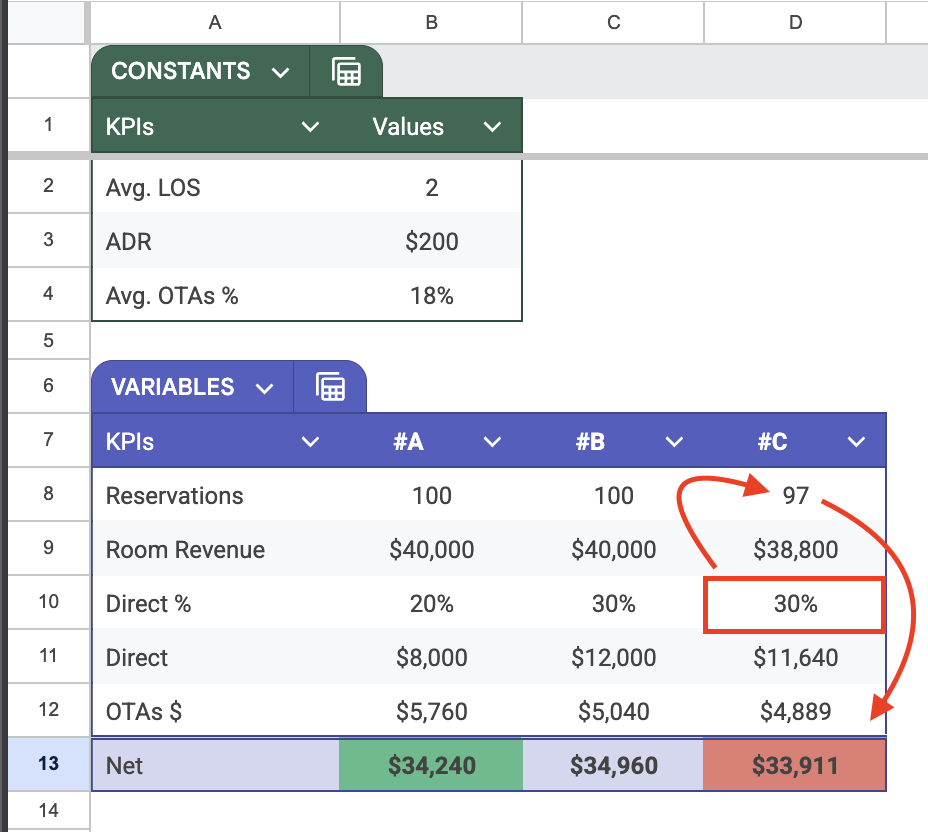
The scenario B is what hoteliers imagine. The scenario C is what actually happens.
Why this happens: how OTAs actually work
OTAs are businesses. No matter how obvious that sounds, it apparently isn’t for many.
More specifically, they are e-commerce businesses.
Not charity organizations, not neutral marketplaces, not passive listing services.
They’re businesses optimizing for their own revenue. And like any e-commerce platform, they give visibility to products that perform well… and bury products that don’t.
Think about it from Booking.com’s perspective.
They have two hotels in the same area. Both get 10,000 impressions in their first month.
- Hotel A converts at 1%.
- Hotel B converts at 3%.
Why would Booking keep giving the same visibility to Hotel A in the second month?
Hotel A generates fewer bookings, less commission revenue, and wastes impression inventory that could go to better-converting properties.
So the algorithm adjusts. Hotel B gets more visibility. Hotel A gets less.
This is basic e-commerce, business logic. Amazon does it. Every marketplace does it. OTAs do it too.
Now back to your hotel.
When you push for more direct bookings, what are you actually doing?
You’re pulling conversions away from OTA channels. A guest who would have booked through Booking.com now books on your website instead.
From your perspective, you saved 18% commission.
From Booking’s algorithm perspective, your conversion rate just dropped.
Lower conversion rate means lower performance score.
Lower performance score means less visibility in search results.
Less visibility means fewer guests even see your property when they search.
The demand doesn’t disappear. Still the OTAs have to power, the tools and the benefit of steering traffic at will, by showing or hiding properties at will.
Check this out:

Above, just a regular search conducted on Booking[dot]com. Beneath, the exact same search, conducted in the exact same moment, with only three differences:
- I was not logged on with my Booking[dot]com account
- I used incognito mode (thus no cookies, no history)
- I used a VPN to connect to another country.

Result: more traffic going to the hotel next to yours that’s still converting well on OTA channels.
You optimized for commission savings. The algorithm optimized you out of the game.
OTAs are a ranking system
Hotels consider OTA commissions as a cost. 18% (or 15%, or 22%, 25%…) per booking.
In reality you are paying to participate in a ranking system that controls most of your visibility.
Perform well on OTA channels and the algorithm gives you more visibility. More visibility brings more demand to your property.
Perform poorly and the algorithm reallocates that visibility to competitors. A guest searching for hotels in your area still sees 10 results on the first page. Your property isn’t one of them anymore.
In the previous example, the hotel went from 100 bookings to 97. Those 3 bookings went to other hotels in the area that maintained better OTA performance. Hotels that kept converting, kept generating commission revenue for Booking and Expedia, kept their algorithmic priority.
You saved commission on individual bookings and lost access to the demand pipeline.
When does it make sense to push for direct bookings? When should you prioritize OTA performance instead?
High season vs low season: when to push direct
The timing changes everything.
High season means strong demand. More guests searching for your destination than available rooms. Your occupancy stays high regardless of where bookings come from.
In this context, you can afford to sacrifice some OTA visibility. The algorithm might deprioritize you slightly, but demand is abundant enough that you’ll still fill rooms.
Focus on margins. Each percentage point of direct bookings you gain saves commission without risking total volume.
Low season works differently. Demand drops below supply. Every point of visibility matters because guests have more options and you’re competing harder for each booking.
You need OTA algorithms working in your favor. High conversion rates and low cancellation rates keep you ranked well in search results. Better ranking means more visibility. More visibility means you capture a larger share of the limited demand available.
Pushing for direct bookings during low season backfires. You reduce OTA conversions, the algorithm deprioritizes you, and you lose visibility exactly when you need it most. Your competitors who maintain strong OTA performance capture the bookings you would have gotten.
That’s why at DirectYourBookings, we developed a framework called SGMS (Single Goal Micro Strategy Method) to handle this dynamic. The approach changes based on seasonality rather than applying one strategy year-round.
During high season, your goal shifts to maximizing margins. This is when you invest in direct booking campaigns, offer exclusive deals on your website, potentially break rate parity if your market allows it.
You’re deliberately accepting lower OTA conversion rates because demand is strong enough to absorb that tradeoff. The commission savings compound quickly when occupancy would be high anyway.
During low season, your goal shifts to maximizing visibility and capturing every available booking. This means keeping your OTA performance strong.
Competitive rates on OTA platforms, fast response times to inquiries, low cancellation rates. You want the algorithm to see you as a reliable, high-converting property.
The commission you pay becomes the cost of staying visible in a crowded market where every booking counts.
The framework requires monitoring your market demand patterns and adjusting your distribution strategy accordingly. Track your total net revenue each month alongside your direct booking percentage.
Some months, a 25% direct rate with 100 bookings will outperform a 35% direct rate with 93 bookings. The percentage alone tells you nothing about actual profitability.
Conclusion
Most hotels optimize for the wrong metric.
They chase direct booking percentages without calculating what happens to total revenue. They celebrate hitting 30% or 40% direct while ignoring that their net revenue dropped compared to the previous quarter.
The math shown earlier is straightforward. Scenario A (20% direct, 100 bookings) generates more net revenue than Scenario C (30% direct, 97 bookings). You increased direct bookings… and lost money.
The solution requires thinking seasonally. High season lets you prioritize margins through direct bookings because demand stays strong even if OTA visibility drops. Low season requires prioritizing OTA performance to maintain visibility when competition for limited demand intensifies.
Run your own numbers. Take your current booking mix and model what happens if you increase direct bookings by 10%. Assume a corresponding 3-5% drop in total volume due to reduced OTA visibility. Compare the net revenue between scenarios.
You might find that your current distribution mix is already optimal. Or you might discover you’ve been leaving money on the table by chasing the wrong goal.